SFOS Newsletter
Spring 2008
FEATURED STUDENT: Jeremy Kasper, Ph.D. Physical Oceanography
by Carin Stephens, SFOS Public Information Officer
Jeremy Kasper loves the outdoors. Originally from Wellesley, Massachusetts, Jeremy received his bachelor’s degree in physics from Reed College. Jeremy joined SFOS in 2001 when he started a Ph.D. program in physical oceanography with Tom Weingartner as his advisor. He plans on graduating this fall.
Jeremy Kasper searches the horizon for polar bears while on an expedition in the western Arctic in 2003. Photo by Chris Linder, Woods Hole Oceanographic Institution.
What first brought you to Alaska?
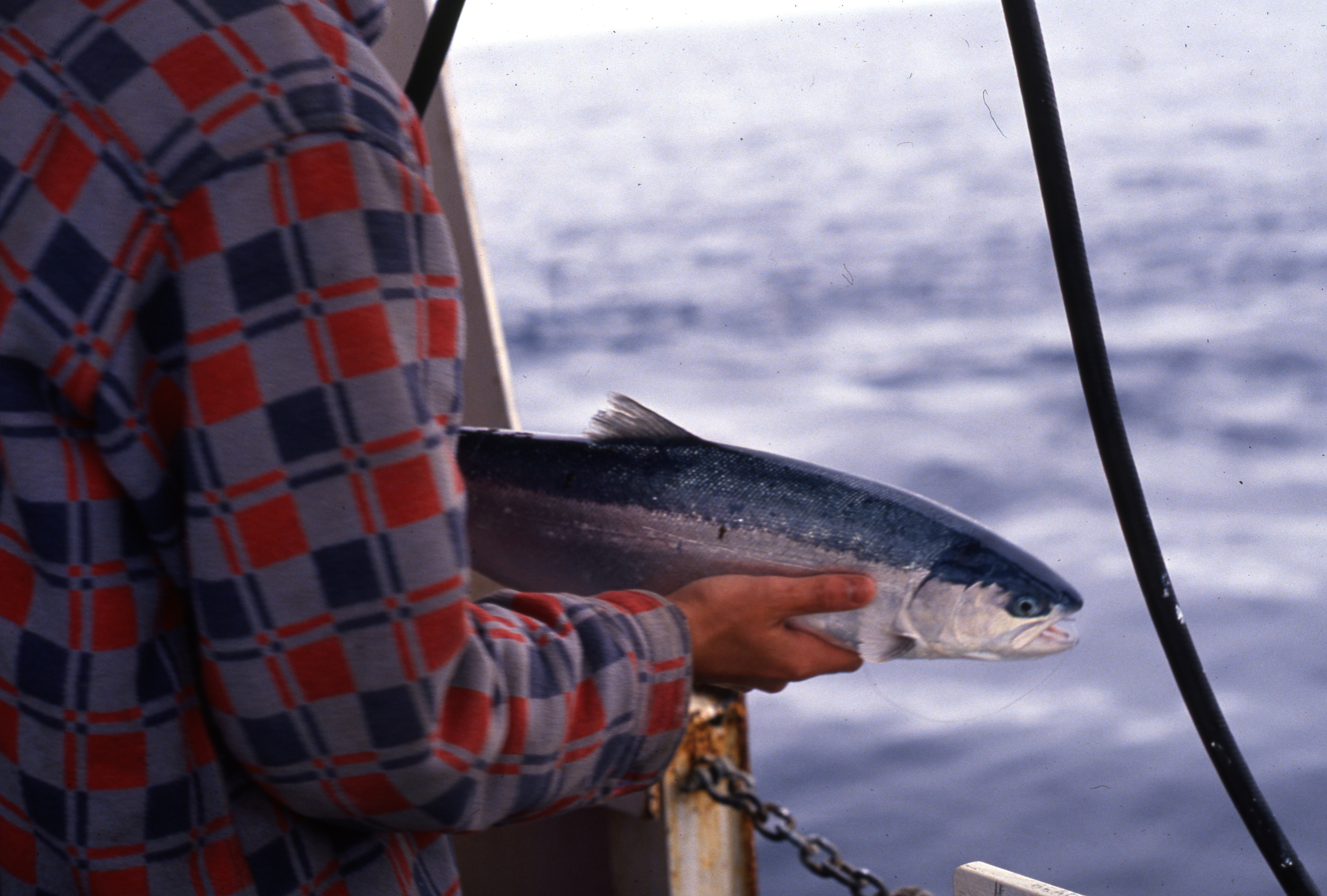
When I was an undergraduate I was just always interested in being outside, and physics really wasn’t an ideal field for that. After freshman year I saw a sign at school that said “come work in Alaska and make tons of money!” so I signed up for that. I ended up working as a “slimer" on a floating fish processor, out in the Aleutians, owned by Icicle Seafoods.
What is a “slimer"?
After the fish come off the cleaning, there’s a chute that drops the fish down off the deck into the header and gutter machine, after they come out of that, they come to the “slimers”. Slimers have these dull knives just to wipe out the inside of the salmon. It’s probably the dirtiest job on the boat and everyone knows who you are because you are covered in fish guts all the time.
After junior year, I started looking for a job. I was looking for a job that hopefully involved both the outdoors and physics. After I graduated, I found a job up at the University of Alaska Fairbanks, but this job still didn’t get me outside, so I took a position as a hydrology technician at the Water and Environmental Research Center. I didn’t really know anything about hydrology, but I got to work outside in sites all over Alaska, on the North Slope and on the Seward Peninsula.
How did you decide to become an oceanographer?
Right around when I started the hydrology job, I also enrolled in Tom Weingartner’s Waves and Fluids class. While taking the course my job sent me out to the Seward Peninsula to spend six weeks outside observing break-up, taking snow samples a couple of times a day.
When I was spending all that time in the Arctic during break-up, I had a lot of time to think-- maybe too much time to think. I thought, where is all this water going? Why does it really matter? I began getting interested in the oceanography aspect of it. After that, I applied for grad school in fall 2001. I was accepted and I started working with Tom as my advisor.
Do you like studying in Alaska?
I love being here and I plan to stay. I love the fact that Alaska is so wide open. I can go cross-country skiing out my door and just keep on going. It is just an incredible place to be. I love the wildlife and the wide open spaces.
What are you studying for your Ph.D.?
Of course, like many graduate students starting out, I initially wanted to study everything. I ended up picking ocean circulation under land-fast ice. I’m running an ocean modeling system, called ROMS (Region Ocean Modeling System).
With ROMS, I can replicate an ocean system by entering different variables, like salinity, depth, wave velocity, etc., and the system will solve equations to tell me what might happen if those variables are changed. I can apply wind to the top, or make a river come in, or heat water at the top, and see what happens to the whole system as it evolves with time.
More specifically, I’ve created an ocean system to replicate the land-fast ice off of the North Slope, in the Beaufort Sea.
Firstly, what is “land-fast ice”?
Land-fast ice is the seasonal ice that is connected to the land in winter, basically between late October through July. It is floating on top of the ocean but connected to the shore so it is not moving. This is the ice that polar bears use to come ashore and where Barrow residents head out to hunt bowhead whales.
What are you looking for?
I’m looking at what is driving the circulation of the water underneath the land-fast ice.
What are you finding out about the circulation of the ocean under the ice?
The land-fast ice is exerting a friction on the ocean beneath. The magnitude of that friction changes with the ice topography, with how rough the underside of the ice is. We are finding that the roughness of the underside of the ice directly affects the circulation of the water beneath. For example, if you have really rough ice near Barrow and really smooth ice near Prudhoe Bay, then that can drive the direction of the flows underneath the ice.
Imagine yourself standing on some of this ice, over a hole and looking down. The water is a vertical column with multiple layers. The thin top layer of water is flowing from under the ice out towards open water. Beneath that layer is a layer of water coming from out in the open ocean. This is the layer that is probably bringing nutrients in from the open ocean.
How could people benefit from your research?
There is increasing interest in offshore oil development in this region and we don’t really have a good idea what is driving the currents under the sea ice. We are trying to figure out what is driving these under-ice currents and that will give us an understanding of what would happen under the ice if there were a spill.
How do rivers on the North Slope affect the land-fast ice?
The rivers, like the Sagavanirktok and the Colville, are frozen until break-up. When the rivers thaw, they discharge out into the land-fast sea ice. The rivers run over, under and through the sea ice, melting it. It flows out over the ice, sometimes finding holes and scouring down the holes. The holes can be from seals or from flaw leads in the ice. Either way, that’s what makes the land-fast sea ice melt rapidly in June/July.
What about climate change and the ice?
Since the area of the ocean I'm studying, the near shore/inner shelf is the transition zone between the land and the open ocean and I'm studying the Arctic--the effects of climate change will be acutely felt and already are being observed there. A different climate means a different landfast ice regime--maybe not as stable and maybe more breakout events during the winter where big leads open up unexpectedly. Also the winds will most likely be different, maybe stronger or weaker but I'll definitely be examining the full range of these parameters under various "climate change scenarios" to get a feel for how things might vary in a different climate. I'm guessing the biggest effect of climate change on the under ice circulation will be through changes in the landfast ice--residents of coastal villages are already reporting more unpredictable ice conditions during the spring-- and in the hydrology of north slope rivers. The first order guess about climate change is a warmer Arctic--which would mean more snow on the North Slope. This would change the amount of snow released during breakup. The ocean would see the downstream effects of this as more river runoff. This would change the shelf conditions, temperature, salinity, circulation, nutrients, biological productivity and so on up the line. So sometime this summer I'll be looking at these issues in more detail. That said, the effect that everyone is noticing now and that is causing tons of problems is the later freeze up date: later freeze up means the coast is exposed to more big fall storms. Consequently there is a lot of coastal erosion occurring and lots of damage done to infrastructure. My research mostly concentrates on the other end of the season--breakup. So even though the effects I'll be looking for aren't as obvious, the effects could ultimately be more profound than those of a later freezup: changes in shelf circulation during breakup and changes in how freshwater is processed on Arctic shelves has the potential to change local biological productivity and thus affect the coastal residents as the effects move up the food chain. From a global perspective the processing of freshwater on Arctic shelves has very important implications for large scale climate dynamics as well.
Jeremy will be working outside for much of the summer, installing high-frequency radars on either side of the Colville River in the Arctic as part of one of Tom Weingartner’s oceanography projects. He plans on staying at the University of Alaska Fairbanks after graduating and hopes to stay in Alaska for as long as possible.
- Visit Jeremy Kasper's webpage
- Back to Spring 2008 Newsletter